Dean Salakas’ 2025 Retail Naughty & Nice List: Key Lessons for Australian Retailers

January 4, 2026

Share this article

Dean Salakas’ 2025 Retail Naughty & Nice List: Key Lessons for Australian Retailers

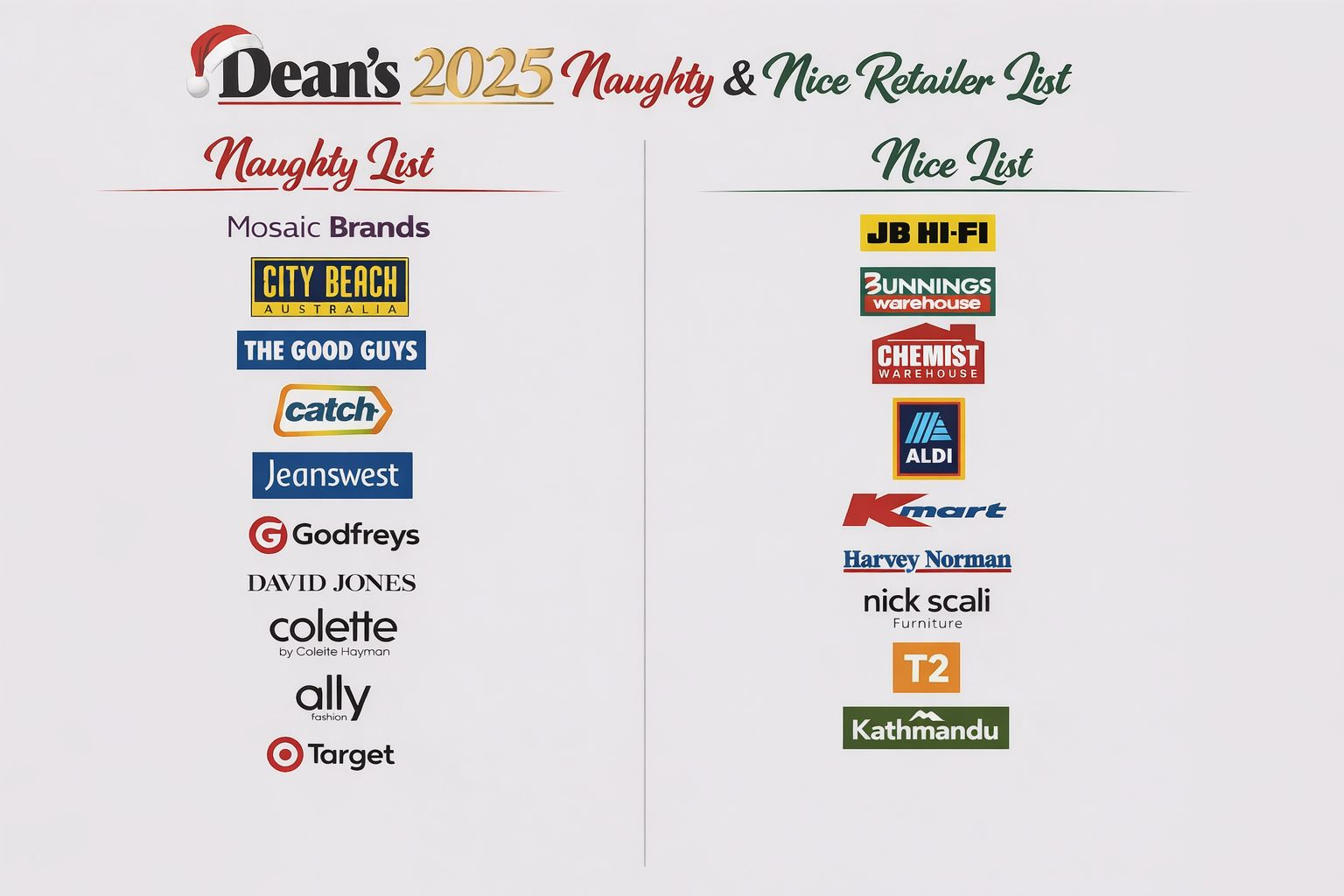
This month, Dean Salakas (Retail Doctor Group) released his highly anticipated 2025 Australian Retail Naughty & Nice List — a definitive review of performance across our nation’s leading retail brands. This list is far more than a ranking: it reflects the core dynamics shaping retail success and failure in 2025, and delivers critical takeaways for all retail operators navigating our competitive market.

We have summarised Dean Salakas’ key findings and curated the core industry reflections for you below, for your reference and strategic planning.

✅ Core Highlights from Dean Salakas’ 2025 Naughty & Nice Retailer List

Dean Salakas’ core premise is clear: Retail success in 2025 has not been driven by luck, but by clarity of positioning, cost discipline, regulatory compliance, operational consistency and timely strategic action.

⚠️ The Naughty List | Key Challenges & Failures

Retailers on this list (including Mosaic Brands Ltd, City Beach, The Good Guys, Target Australia, David Jones, Jeanswest and more) faced significant operational and financial headwinds this year — including administration, liquidation, substantial regulatory fines, revenue decline and store closures.The root causes shared across this cohort are consistent: unsustainable cost structures and years of accumulated losses, critical compliance failures with long-term reputational damage, blind expansion masking weak store-level profitability, structural inefficiencies (high fixed costs, vague market positioning), and delayed strategic change in the face of market shifts. Even strong brand recognition was not enough to offset poor unit economics for many of these brands.

✅ The Nice List | Benchmark Success & Strengths

By contrast, Australia’s top-performing retailers (JB Hi-Fi, Bunnings, Chemist Warehouse, Kmart, ALDI, Officeworks, Harvey Norman and others) delivered exceptional and consistent results in 2025, with strong revenue, healthy profit margins, robust cash flow and high returns on capital.These leading brands all hold core competitive strengths: strict cost and inventory discipline, rock-solid compliance standards, scale and network advantages, mature private label portfolios, resilient balance sheets, and a willingness to adapt — including restructuring, digital investment and experience-led retail innovation. All have mastered the fundamental pillars of sustainable retail success.

🎯 Critical Industry Reflections & Key Takeaways (Derived from Dean Salakas’ Analysis)

For the Australian retail industry, this list is a masterclass in what defines resilience and growth in our current market. These insights are essential for every retail business, large and small:

  1. Fundamentals over fortune: Luck has no place in modern retail. Success is earned through laser-sharp clarity on your core customer base, unwavering cost discipline, and compliance embedded into every operational decision — not an afterthought. No brand is immune to failure if these basics are ignored.
  2. Compliance is non-negotiable competitive advantage: The record fines handed to City Beach and The Good Guys serve as a stark industry warning. Regulatory compliance is not a cost, but a foundational requirement for trust and longevity. A single compliance misstep can cause irreversible reputational and financial harm that far outweighs short-term gains.
  3. Growth must be profitable growth: Rapid, unplanned expansion has proven a fatal trap for many retailers (colette by colette hayman, Ally Fashion). Scale without sustainable unit economics only amplifies risk; strong brand recognition alone cannot rescue a business with flawed operational fundamentals.
  4. Adapt early, or fall behind: Delayed strategic change is the single biggest risk for retailers in 2025. All brands on the Naughty List shared a failure to address structural weaknesses or pivot in response to market pressure — a mistake that leaves no margin for error in Australia’s hyper-competitive retail landscape. Even top performers (Kathmandu, T2 Tea) have invested in restructuring, digital transformation and AI/ data innovation to stay ahead.
  5. Positioning clarity wins in crowded markets: Brands like Target Australia continue to struggle due to a lack of distinct positioning in the value retail space, compounded by high fixed costs and oversized store footprints. This underscores a critical truth: in a saturated market, clear differentiation and laser focus on core customer value are non-negotiable.

✅ Final Key Insight from Dean Salakas

The standout retail winners of 2025 are not perfect — but they are intentional. They know exactly who they serve, they control costs rigorously, they operate with compliance at their core, and they embrace change proactively and early. This is the blueprint for retail resilience in Australia, now and into 2026.

We hope these insights provide valuable context for your business strategy as we head into the new year, and we look forward to bringing together Australia’s retail leaders to connect, learn and innovate at the Retail Show Australia 2026.

Recent Posts

A man with glasses is featured as a keynote speaker at Retail Show Australia 2026.
February 13, 2026
Adam Posner, CEO of The Point of Loyalty, joins Retail Show Australia 2026 to share insights on transforming retail loyalty programs from discount dependency to emotional equity.
Green retail store with solar panels and recycled products.
February 11, 2026
Discover how green retail is transforming Australian stores from marketing concept to core business strategy. Explore low-carbon operations, sustainable sourcing, and renewable energy innovation at Retail Show Australia.
Retail Show Australia 2026. Featured speaker Rush Rheidar from Microsoft.
February 9, 2026
ShiSh Shridhar from Microsoft for Startups joins Retail Show Australia 2026 to explore how agentic AI is transforming retail from automation to business autonomy.
EB Games store interior, heavily decorated with
February 5, 2026
EB Games’ store closures in New Zealand and Australia highlight major structural shifts in ANZ retail. Explore what this means for physical stores, market strategy, and retail growth in 2026 and beyond.
Speaker Nick Gray, wearing glasses and a black hat, smiles against an orange and purple background.
February 4, 2026
Discover how Nick Gray, CEO of IGU Global, explores emotional intelligence as the key to retail success at Retail Show Australia 2026. Learn how human connection drives the next decade of retail leadership.
Tennis ball with
February 3, 2026
How the Australian Open’s record crowds and consumer enthusiasm are driving economic growth in Australia — and what retailers can learn from event-led spending, pop-ups and experiential retail.
Retail Show Australia 2026 advertisement featuring a man smiling, with text overlay, and a logo.
January 29, 2026
Join Bernie Brookes AM, Chairman of the Australian Food and Grocery Council, at Retail Show Australia 2026. Discover insights on AI, emerging technologies, and strategies to build resilient, future-ready retail businesses.
Signpost with flags for Australia and New Zealand, pointing in opposite directions against a blue sky.
January 28, 2026
An analysis of 2025 economic data from Australia and New Zealand, exploring consumer spending, household consumption and what it means for retailers in 2026.
Text
January 27, 2026
How Gamified Commerce is Reshaping Consumer Engagement
Woman with a plaid shirt argues with a cashier at a grocery store checkout counter; both appear frustrated.
By leo zheng January 23, 2026
Retail workers across Australia are facing rising customer abuse and violence
Show More