2025 Retail Trends in Australia and New Zealand

January 28, 2026

Share this article

The year 2025 marked a pivotal period for retail in Australia and New Zealand, as both economies navigated post-pandemic recovery, global inflation pressures, and evolving consumer behavior. By examining the Australian Bureau of Statistics (ABS) National Accounts 2025 and the New Zealand Treasury Annual Report 2025, we can highlight the key trends shaping retail markets in both countries.

1. Australia: Economic Performance and Consumer Spending

Economic Growth

Australia’s GDP maintained steady growth in 2025, with annual growth hovering around 1.4%. Domestic consumption and private final demand were primary drivers of this growth, supporting a resilient retail environment despite global economic uncertainty. Quarterly GDP data show continued positive growth across multiple periods, demonstrating a stable economic foundation for consumer spending. (ABS, 2025)

Retail Consumption

Household spending remained a key engine of retail growth:

  • Expenditure on non-essential categories such as tourism, cultural activities, and transportation saw notable increases.
  • Household savings rates slightly recovered, reflecting cautious consumer sentiment while maintaining disposable income for discretionary purchases.
  • Retail category performance varied: home furnishings, electronics, and experiential retail showed strong growth, while clothing and certain durable goods experienced cyclical fluctuations.


Overall, 2025 was characterized by moderate retail growth, supported by promotional events like Black Friday and Boxing Day sales, which significantly boosted discretionary spending.

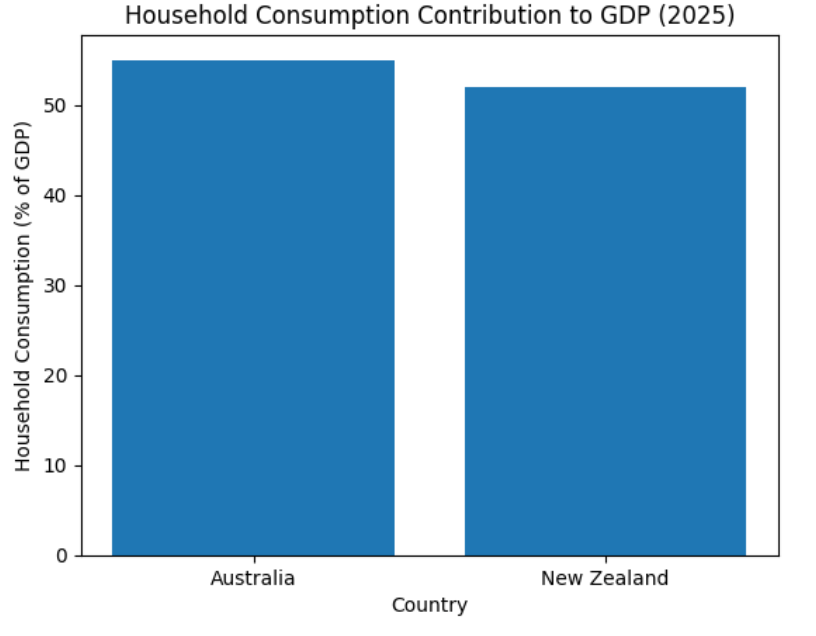
Household Consumption Contribution to GDP (2025)

Household Consumption Contribution to GDP (2025)


2. New Zealand: Economic Context and Retail Environment

Economic Performance

According to the New Zealand Treasury Annual Report, 2025 was a year of gradual economic recovery amid global trade fluctuations and domestic productivity challenges. GDP showed stage-wise improvements, particularly in the third quarter, signaling a cautious but positive recovery. Inflation remained moderate, while fiscal and monetary policies aimed to support consumption and investment. (NZ Treasury, 2025)

Retail Trends


  • Retail activity improved in later quarters, reflecting a gradual rebound in consumer confidence and spending.
  • Growth was most pronounced in electronics, essential goods, and tourism-related purchases, whereas traditional retail segments, such as clothing and department stores, faced intensified price competition.


In summary, New Zealand’s retail sector experienced moderate growth, recovering gradually from earlier market softness, with a cautious consumer base balancing necessity and discretionary spending.

3. Cross-Country Comparison and Insights

Key Drivers:

1.Household Consumption:

  • Both countries relied heavily on household expenditure as a GDP growth driver. Australia saw more robust contributions from consumer spending, particularly in discretionary categories.

2.Retail Structural Shifts:

  • Australia: Growing integration of online and offline retail channels; digital platforms increasingly influencing overall sales.
  • New Zealand: Retail growth was concentrated in essential goods and tourism-related consumption, reflecting a cautious recovery.

3.Policy Influence:

  • Australian monetary and fiscal measures supported consumer spending and overall economic stability.
  • New Zealand’s coordinated fiscal and monetary policy provided gradual support for retail and investment activity.
Household Consumption Contribution to GDP (2025)

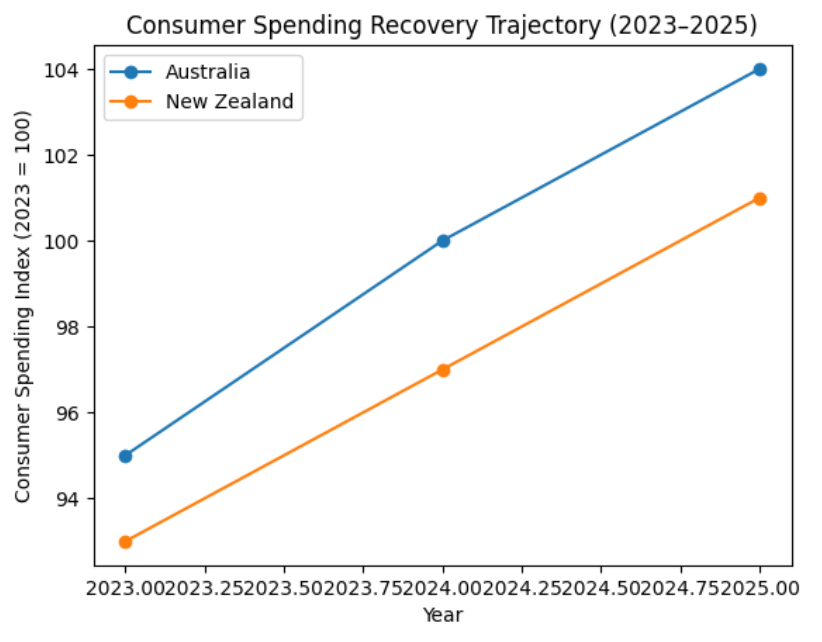
Consumer Spending Recovery Trajectory (2023–2025)

4. Retail Trends and Outlook for 2026

Growth Outlook:

  • Both countries are expected to maintain positive retail growth into 2026, although the pace may be influenced by global supply conditions and policy adjustments.

Consumer Behavior:

  • Consumers are increasingly favoring experiential and essential consumption while showing caution in purchasing high-value durable goods.

Industry Challenges:

  • Traditional retail formats face increasing pressure from digital platforms and price-sensitive consumers.
  • Supply chain volatility and fluctuating consumer confidence remain important factors for retailers to monitor.

Strategic Recommendations:

  • Enhance omnichannel strategies combining digital and in-store experiences.
  • Adjust pricing strategies dynamically in response to consumer sensitivity.
  • Optimize inventory and supply chain management using data-driven insights.

5. Reference

  • Australian Bureau of Statistics (ABS), National Accounts: National Income, Expenditure and Product, 2025 (ABS)
  • New Zealand Treasury, Annual Report 2025 (NZ Treasury)

Recent Posts

A man with glasses is featured as a keynote speaker at Retail Show Australia 2026.
February 13, 2026
Adam Posner, CEO of The Point of Loyalty, joins Retail Show Australia 2026 to share insights on transforming retail loyalty programs from discount dependency to emotional equity.
Green retail store with solar panels and recycled products.
February 11, 2026
Discover how green retail is transforming Australian stores from marketing concept to core business strategy. Explore low-carbon operations, sustainable sourcing, and renewable energy innovation at Retail Show Australia.
Retail Show Australia 2026. Featured speaker Rush Rheidar from Microsoft.
February 9, 2026
ShiSh Shridhar from Microsoft for Startups joins Retail Show Australia 2026 to explore how agentic AI is transforming retail from automation to business autonomy.
EB Games store interior, heavily decorated with
February 5, 2026
EB Games’ store closures in New Zealand and Australia highlight major structural shifts in ANZ retail. Explore what this means for physical stores, market strategy, and retail growth in 2026 and beyond.
Speaker Nick Gray, wearing glasses and a black hat, smiles against an orange and purple background.
February 4, 2026
Discover how Nick Gray, CEO of IGU Global, explores emotional intelligence as the key to retail success at Retail Show Australia 2026. Learn how human connection drives the next decade of retail leadership.
Tennis ball with
February 3, 2026
How the Australian Open’s record crowds and consumer enthusiasm are driving economic growth in Australia — and what retailers can learn from event-led spending, pop-ups and experiential retail.
Retail Show Australia 2026 advertisement featuring a man smiling, with text overlay, and a logo.
January 29, 2026
Join Bernie Brookes AM, Chairman of the Australian Food and Grocery Council, at Retail Show Australia 2026. Discover insights on AI, emerging technologies, and strategies to build resilient, future-ready retail businesses.
Text
January 27, 2026
How Gamified Commerce is Reshaping Consumer Engagement
Woman with a plaid shirt argues with a cashier at a grocery store checkout counter; both appear frustrated.
By leo zheng January 23, 2026
Retail workers across Australia are facing rising customer abuse and violence
Brown paper bag with a smiley face on an orange background.
January 22, 2026
Explore how emotional branding is transforming consumer behavior in retail and FMCG. Discover strategies for building authentic,
Show More